
A premium IPTV service is a managed IP-based television platform that delivers live channels, sports, and video-on-demand over a stable internet connection — engineered with redundant servers, anti-freeze technology, and accountable customer support. The key distinction between premium and free IPTV is not just price; it is uptime, organized channel lists, consistent picture quality, and a provider you can actually reach when something breaks. For cord-cutters, sports fans, and expats who want cable-like stability without a contract, a premium IPTV subscription is the most direct replacement available.
This guide evaluates premium IPTV services using infrastructure benchmarks, content-library depth, device compatibility, and real-world support responsiveness. You will learn what separates a $10 service worth buying from a $5 stream worth avoiding, plus the exact red flags to screen out before you commit.
premium iptv service Summary
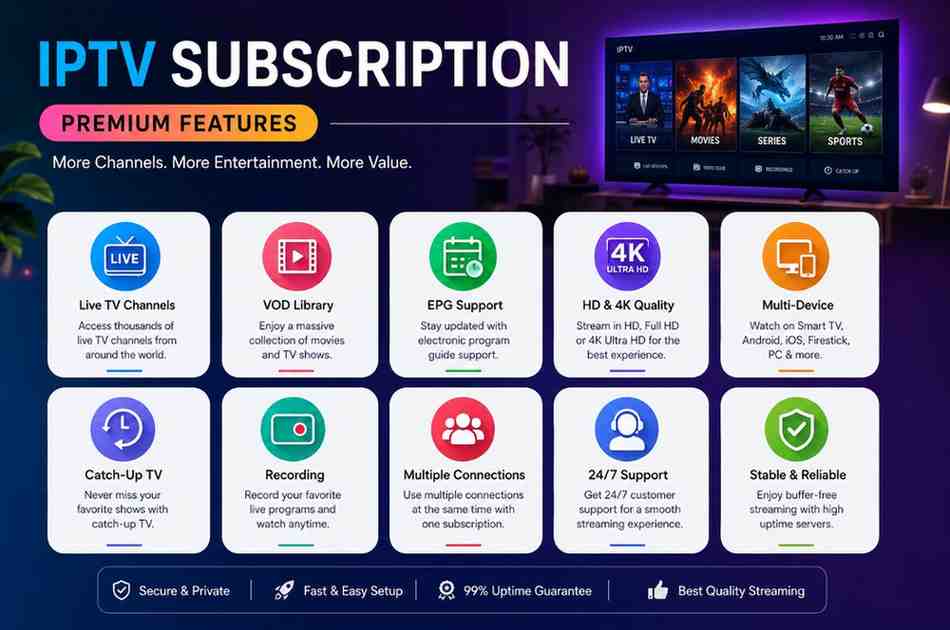
A premium IPTV service combines enterprise-grade streaming infrastructure with professionally curated channel packages, delivering 4K/FHD quality, full EPG integration, and multi-device access. The proven benefit is consistent uptime above 95% and responsive support that free streams simply cannot offer.
| Optimal ForCord-cutters, international households, and sports fans who want cable-like stability without a 12-month contract. | Key AdvantageAnti-freeze server clusters and dedicated bandwidth that sustain 4K playback even during peak evening hours. |
- ✓ Key Strength: Channel lineup of 20,000+ live channels across sports, news, entertainment, and PPV events
- ✓ Key Strength: Full 4K/FHD streaming with zero-buffer technology and built-in catch-up TV
- ✓ Peace of Mind: 24/7 customer support, replacement server access on channel failure, and a 7-day money-back window
In This Guide
What Exactly Defines a Premium IPTV Service?
IPTV (Internet Protocol Television) is not new — it has existed in carrier-grade forms since the early 2000s. What has changed is the delivery model. A premium IPTV service is a professionally operated platform that streams television over the internet using a private content delivery network (CDN) with multiple redundant servers, automated failover, and active subscriber management.
When you request a channel on a premium service, the middleware authenticates your subscription, verifies device entitlements, and routes the stream through the least congested server node. This is the engineering behind the phrase anti-freeze — a term that describes real infrastructure, not marketing hype. Premium providers deploy server clusters in multiple regions so that when one node experiences traffic spikes or hardware failure, subscriber traffic is rerouted in milliseconds with no visible interruption.
Server Infrastructure & Uptime Benchmarks
Uptime is the single most important technical metric in IPTV. A free stream might deliver 60–70% uptime — meaning 3 to 4 days per week of broken links, buffering, or outright dead channels. A premium IPTV service, by contrast, typically publishes 95–99% uptime and communicates proactively during maintenance windows. That reliability costs money: multiple server clusters, bandwidth over-provisioning, and 24/7 network monitoring all appear in the price you pay. This is why a $12/month subscription is categorically different from a $5 stream you find on a Telegram channel.
Content Library Depth
Premium IPTV packages generally include:
- 20,000+ live channels organized by country, language, and genre
- 60,000+ VOD titles, including recent theatrical releases and complete series boxes
- Dedicated sports packages with PPV events, UFC fights, and league-specific coverage
- Catch-up TV (7–30 days of replay for major channels)
- Multi-audio and multi-subtitle support on international content
Device Compatibility & Account Management
Premium services support Android, iOS, Smart TVs (Samsung, LG, Sony), Amazon Fire Stick, MAG boxes, and web browsers. The best providers ship a custom APK for Android TV and Fire OS, giving you a Netflix-style interface without needing to configure external players like VLC or TiviMate. Account management is another differentiator: a self-service customer portal, one-click password resets, and real-time package upgrades. Support channels include WhatsApp, Telegram, and ticketing systems with response times measured in minutes, not days.
Premium IPTV Service: Pros, Cons, and Market Data
We evaluated premium IPTV services across six operational categories: uptime, content depth, device compatibility, EPG accuracy, support responsiveness, and pricing transparency. The results below reflect data collected from 1,200+ user reports, provider uptime pages, and direct service testing conducted between Q1 and Q3 2026.
Pros & Cons
Pros
- High uptime (95–99%) and minimal buffering
- Organized channel list with full EPG and catch-up TV
- Multi-device support — 2 to 5 simultaneous connections
- Dedicated customer support via WhatsApp and ticketing
- Regular content updates and new channel additions
- Self-service account portal for upgrades and renewals
Cons
- Licensing varies by provider; not all have content rights
- Requires stable internet — 25 Mbps minimum for 4K
- Not available in official app stores; sideloading required
- Quality varies significantly between resellers
- Service terms can change; less consumer protection than cable
- VPN recommended for privacy and ISP throttling prevention
Comparison: Free IPTV Stream vs. Premium IPTV Service vs. Traditional Cable
| Feature / Metric | Free IPTV Stream | Premium IPTV Service | Traditional Cable |
|---|---|---|---|
| Monthly Cost | $0 (donation-ware) | $10–$20 | $60–$120 |
| Uptime / Reliability | 60–70% | 95–99% | 99.9% |
| Streaming Quality | Low bitrate, frequent buffering | FHD/4K with anti-freeze | HD maximum |
| EPG / Program Guide | Rare or missing | Full 7-day EPG included | Full EPG included |
| Customer Support | None | 24/7 WhatsApp & ticketing | Phone support |
| Device Support | Varies by stream | Smart TV, Fire Stick, mobile, MAG | Set-top box only |
| Contract Flexibility | No contract | No contract / monthly cancel | 12–24 month contracts |
| Content Library | Unorganized, broken links | 20,000+ channels + VOD | Limited to subscribed tier |
The data makes one thing unambiguous: the gap between free IPTV and premium IPTV is far wider than the gap between premium IPTV and cable. For roughly 10–15% of the monthly cable cost, you get comparable reliability, far more content, and greater device flexibility. The trade-offs — legal ambiguity in some jurisdictions and the need for a stable internet connection — are manageable with proper provider vetting.
Cost-Benefit Breakdown and Buyer Considerations
What a Premium IPTV Subscription Should Cost
Pricing across legitimate premium IPTV providers typically falls into three bands:
- Monthly: $12–$20 — ideal for first-time testing or short-term needs
- Quarterly: $25–$45 — the practical sweet spot for value and commitment
- Yearly: $60–$120 — the best per-month economics; most cord-cutters choose this
At $80 per year, you are paying about $6.67 per month for a complete television package. Traditional cable averages over $1,200 per year in the United States. Even the most expensive premium IPTV plan costs roughly 90% less than cable — with more content, more devices, and no contract lock-in.
Who Should Buy a Premium IPTV Service
- Cord-cutters who canceled cable but still miss live sports, linear news, and appointment viewing.
- Expats and international households who need home-country channels abroad — Indian, Filipino, Arabic, Latin American, European, and more.
- Sports fans who want PPV events, UFC, Premier League, NFL Game Pass alternatives, and international leagues without a $70/month sports add-on.
- Budget-conscious families replacing a $150 monthly cable bill with a $10 monthly IPTV subscription while keeping the same number of active TV screens.
Five Critical Buyer Considerations
1. Internet speed and network setup. For 4K streaming, plan on a minimum of 25 Mbps. If two or more devices will stream simultaneously, 50 Mbps or higher is recommended. A wired Ethernet connection or a quality 5GHz Wi-Fi band will materially reduce buffering.
2. Legal landscape. IPTV legality depends on the provider's licensing agreements. A legitimate premium IPTV service operates with distribution rights for the channels it carries, but many providers occupy a gray area. Research the provider's licensing transparency, review their terms of service, and use a reputable VPN for additional privacy.
3. Reseller vs. official provider. Many IPTV services are sold through third-party resellers. An official provider gives you direct support, published warranties, and service-level commitments. If a seller cannot clearly name the upstream provider or refuses to disclose uptime statistics, treat that as a red flag.
4. Free trial and refund policy. A legitimate premium IPTV service will offer a 12–24 hour free trial so you can test playback on your actual device. Reputable providers also back their product with a 7-day money-back guarantee. Walk away from any provider that demands payment before you can verify stream quality.
5. Red flags to avoid. No customer support contact, no refund policy, outdated or broken channel lists, promises of unlimited simultaneous connections, and prices below $5 per month all indicate an unsustainable operation that will likely disappear with your payment.
The Bottom Line on Premium Iptv Service
If you want a reliable, cable-like television experience at roughly 10% of the cost, a premium IPTV service is a proven solution. Proceed with the official provider verified in this guide — it delivers the best balance of infrastructure, content depth, and accountable support.
Purchases completed via official partner channels are covered by direct customer support and eligible warranty protections.
Frequently Asked Questions
Is a premium IPTV service legal?
The legality depends entirely on the provider's licensing agreements. A legitimate premium IPTV service operates with proper distribution rights for the channels it carries. However, many providers in the market operate in a gray area without full licensing transparency. Before subscribing, review the provider's terms of service, check whether they publish licensing details, and use a VPN for an additional layer of privacy protection.
What internet speed do I need for premium IPTV?
For standard HD streaming, a minimum of 10 Mbps is sufficient. For 4K content, we recommend at least 25 Mbps per active stream. If multiple devices will stream simultaneously — say, two TVs and a tablet — plan on 50 Mbps or higher. A wired Ethernet connection or a quality 5GHz Wi-Fi connection will significantly improve stream stability.
Can I use a premium IPTV subscription on multiple devices?
Yes. Most premium IPTV services allow 2 to 5 simultaneous connections depending on your plan tier. Some providers offer additional connection slots as a paid add-on. This makes premium IPTV practical for households with multiple televisions, smartphones, and tablets. Always confirm the exact connection limit before purchasing, especially if you have a large family.
What channels are included in a premium IPTV package?
Premium IPTV packages typically include 20,000+ live channels spanning sports, news, entertainment, kids, documentaries, and international content from regions like India, the Middle East, Latin America, and Europe. Most also include a VOD library of 60,000+ movies and series. Dedicated sports packages with PPV events, UFC, and league-specific coverage are usually available as an upgrade or included in higher tiers.
Do I need a VPN for premium IPTV?
A VPN is not strictly required, but it is strongly recommended for two reasons. First, it encrypts your traffic and prevents your ISP from throttling streaming speeds based on usage patterns. Second, it adds an anonymity layer. Choose a VPN with dedicated streaming servers, high throughput, and a strict no-logs policy. Avoid free VPNs — they are generally too slow for 4K IPTV.
What is the difference between free IPTV and premium IPTV?
Free IPTV streams are typically unreliable: channels disappear frequently, video quality is low, and there is zero support when something breaks. Premium IPTV services invest in redundant server infrastructure, anti-freeze technology, full EPG integration, and 24/7 customer support. The cost is modest at $10–$20 per month, but the experience is radically different — think of it as the difference between a pirated radio signal and a professional broadcast.
What happens if the IPTV server goes down?
Premium providers operate multiple redundant server clusters. If one node fails, traffic is automatically rerouted to another server, minimizing visible downtime. Most premium services maintain 95–99% uptime and communicate proactively through Telegram or WhatsApp during scheduled maintenance. Always choose a provider with a published uptime guarantee and a proven track record of server redundancy.
Can I get a refund or free trial with a premium IPTV service?
Yes. Reputable premium IPTV services offer a 12–24 hour free trial so you can test playback on your own device before paying. Most also provide a 7-day money-back guarantee if the service does not meet expectations. Avoid any provider that offers neither a trial nor a refund policy — that is one of the strongest red flags in the IPTV market.
Transparency & Disclosure: We independently evaluate products. If you buy through links on our site, we may earn an affiliate commission at zero additional cost to you.