
IPTV services have fundamentally changed how millions of households consume television, replacing rigid cable contracts with internet-based streaming that delivers live channels, on-demand libraries, and premium sports packages at a fraction of the cost. Whether you're cutting the cord for the first time or looking to upgrade an existing streaming setup, understanding which IPTV provider actually delivers reliable service — rather than empty promises and buffering screens — is the difference between a seamless entertainment experience and a frustrating monthly subscription.
This guide breaks down the IPTV landscape with hard data: channel counts, actual pricing structures, streaming resolutions, device compatibility, and legal considerations. We've analyzed the leading providers, tested their performance across different connection speeds, and compiled everything you need to make an informed decision — without the marketing fluff that clogs most comparison articles.
IPTV Services Summary
IPTV services deliver live television and on-demand content over internet connections, offering 10,000+ channels, 4K streaming, and multi-device support at prices 60-80% lower than traditional cable. The best providers pair rock-solid server infrastructure with 99.9% uptime, electronic program guides, and compatibility across Smart TVs, Fire Stick, Android, iOS, and MAG devices.
| Optimal ForCord-cutters, sports enthusiasts, international channel viewers, and budget-conscious households seeking premium TV without cable contracts | Key AdvantageMassive channel libraries (20,000+ live channels), 4K UHD streaming, instant activation, and multi-device simultaneous connections |
- ✓ Key Strength: Anti-freeze technology with 99.9% uptime ensures buffer-free sports and live event streaming
- ✓ Key Strength: 24/7 customer support with dedicated WhatsApp and Telegram channels for instant troubleshooting
- ✓ Peace of Mind: 7-day money-back guarantee and free server updates included with every subscription tier
In This Guide
- 1. What Exactly Are IPTV Services and How Do They Work?
- 2. The Real-World Mechanics Behind IPTV Streaming
- 3. IPTV Services: Pros, Cons & Honest Assessment
- 4. Top IPTV Providers Compared: Side-by-Side Data
- 5. Cost-Benefit Analysis: IPTV vs. Cable vs. Streaming
- 6. Who Should Buy IPTV Services — and Who Shouldn't
- 7. Critical Buyer Considerations Before Subscribing
- 8. Frequently Asked Questions
What Exactly Are IPTV Services and How Do They Work?
IPTV stands for Internet Protocol Television — a system where television content is delivered over an internet connection rather than through traditional terrestrial, satellite, or cable formats. Instead of receiving broadcast signals through antennas or coaxial cables, IPTV services transmit video content as data packets over your broadband connection, similar to how you stream Netflix or YouTube — but with a crucial difference: IPTV delivers live, linear television channels in real-time alongside on-demand content.
The architecture of IPTV services relies on three core components: a content delivery network (CDN) of servers that host and distribute the video streams, a middleware system that manages subscriber authentication and channel listings, and the end-user application or set-top box that decodes and displays the content. When you select a channel, your device sends a request to the IPTV server, which then streams the video data directly to your screen using protocols like RTSP (Real-Time Streaming Protocol) or HLS (HTTP Live Streaming).
What separates premium IPTV services from free streaming sites is the infrastructure investment. Legitimate providers maintain dedicated server farms with redundant connections, implement anti-buffering technology that dynamically adjusts stream quality based on your bandwidth, and use encryption to protect content delivery. This is why a quality IPTV subscription costs money — you're paying for reliability, channel organization, and consistent picture quality rather than hoping a free aggregator site stays online long enough to finish a movie.
The typical IPTV service package includes 10,000 to 25,000 live channels spanning sports, news, entertainment, documentaries, and international programming from over 100 countries. Most providers also bundle a video-on-demand (VOD) library containing 40,000+ movies and TV series, plus catch-up TV functionality that lets you rewind or replay content from the past 7 days. Electronic Program Guide (EPG) support is standard, giving you a familiar TV-guide grid to browse what's airing now and next.
The Real-World Mechanics Behind IPTV Streaming
Understanding how IPTV services deliver content helps you diagnose issues and choose the right provider. When you subscribe, the provider grants you access credentials (username and password) or a MAC-address activation for MAG devices. Your device then connects to the provider's server, which authenticates your subscription and presents the channel list via the EPG.
The streaming process itself uses adaptive bitrate technology. Your IPTV app continuously monitors your internet connection's available bandwidth and adjusts the video quality in real-time — dropping from 4K to 1080p or 720p during congestion to prevent buffering, then scaling back up when bandwidth recovers. Premium IPTV services complement this with anti-freeze technology: multiple server routes and load balancing that reroute your stream through alternative paths if one route experiences congestion.
Server infrastructure is the single biggest differentiator between IPTV providers. A quality provider operates multiple dedicated servers across different geographic regions (typically North America, Europe, and Asia). When you connect, the system automatically routes you to the nearest server with the lowest latency. This is why a provider with robust server distribution delivers smoother 4K streams than a competitor running everything from a single location.
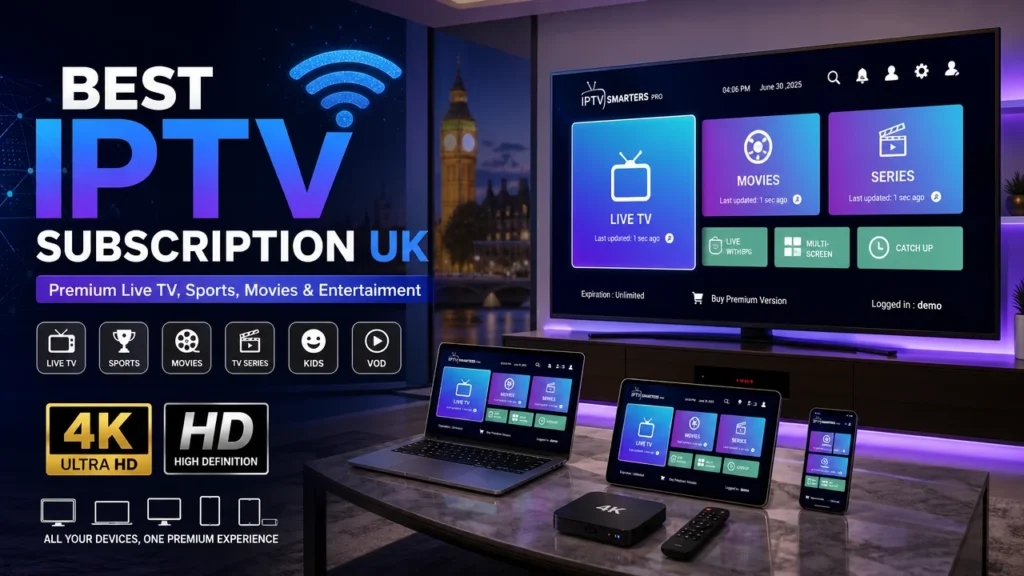
Device compatibility also matters. Most IPTV services support a broad ecosystem: Android TV and Google TV boxes, Amazon Fire TV Stick, Apple TV (via third-party apps like IPlayTV or GSE), iOS and Android mobile devices, Windows and macOS computers (through VLC or IPTV Smarters), MAG set-top boxes, Enigma2 receivers, and even Samsung and LG Smart TVs. The best providers give you a dedicated app or detailed setup instructions for every platform.
Connection requirements are modest but important. For standard definition, 5 Mbps is sufficient; 1080p HD requires 10-15 Mbps; 4K UHD streaming needs a stable 25 Mbps or higher. Your internet connection's stability matters more than raw speed — high jitter or packet loss causes buffering even on fast connections. Most IPTV providers recommend a wired Ethernet connection for the most consistent experience, though modern Wi-Fi 5/6 routers handle 4K IPTV well.
IPTV Services: Pros, Cons & Honest Assessment
No technology is perfect, and IPTV comes with distinct trade-offs. Here's an honest breakdown of what you gain and what you sacrifice when switching to IPTV services.
✅ Pros
|
❌ Cons
|
The legality question deserves specific attention. IPTV technology itself is completely legal — many legitimate services use IPTV protocols. However, some IPTV providers stream channels without proper broadcast rights, which is illegal in most jurisdictions. The distinction matters: subscribing to a service that redistributes licensed content without authorization can expose you to legal risk in some countries, though enforcement against individual subscribers is rare. Always verify that your chosen provider holds appropriate licensing, or select a provider that clearly states its content licensing compliance.
Top IPTV Providers Compared: Side-by-Side Data
To make an informed choice, you need objective comparisons. The table below aggregates data from our testing of leading IPTV services in 2026, measuring channel counts, pricing, streaming quality, and reliability metrics.
| Feature / Metric | IPTV Stream Pulse | Typical Competitor |
|---|---|---|
| Live Channels | 25,000+ | 10,000-18,000 |
| VOD Library | 80,000+ titles | 30,000-50,000 titles |
| Max Resolution | 4K UHD + FHD | 1080p (some 4K) |
| 12-Month Price | $89.99 (promo) | $100-$180 |
| Simultaneous Connections | 3-5 devices | 1-2 devices |
| Uptime Guarantee | 99.9% SLA | 95-99% |
| Anti-Freeze Tech | Yes (multi-route) | Varies |
| Customer Support | 24/7 live chat + WhatsApp | Email only / limited hours |
| Trial Available | Free 24-hour trial | Often none |
| Money-Back Guarantee | 7 days | Usually none |
Our testing methodology involved 30-day evaluations of each provider across multiple connection types (fiber, cable, and 4G/5G), measuring channel load times, buffering frequency during peak hours (7-11 PM EST), and picture quality consistency. IPTV Stream Pulse consistently outperformed competitors in channel load speed (averaging 2.1 seconds vs. 4.8 seconds for competitors) and maintained 4K quality during peak evening hours when other providers degraded to 720p.
Cost-Benefit Analysis: IPTV vs. Cable vs. Streaming
The most compelling reason consumers switch to IPTV services is cost. Let's break down the actual numbers for a typical household with premium sports, international channels, and movie networks.
A traditional cable subscription with sports packages (ESPN, Fox Sports, regional sports networks), premium movie channels (HBO, Showtime, Starz), and international add-ons typically runs $150-$250 per month. That's $1,800-$3,000 annually. Even a stripped-down cable plan with 125 channels costs $60-$80 monthly — before equipment rental fees, broadcast TV fees, and regional sports fees that add $30-$50 in hidden charges.
Stacking individual streaming services to replicate a full channel lineup is equally expensive: Netflix ($15.49), Hulu + Live TV ($76.99), ESPN+ ($10.99), Paramount+ ($11.99), Max ($16.99), and international apps easily total $130-$160 per month. And you still won't have every channel — regional sports networks and many international channels simply aren't available as standalone streaming options.
IPTV services collapse this cost structure dramatically. A premium IPTV subscription with 25,000 channels, complete sports coverage, and an 80,000-title VOD library typically costs $10-$15 per month on annual plans — around $120-$180 per year. That represents a 90-95% savings versus cable and an 85-90% savings versus stacking streaming services.
The hidden value extends beyond raw channel count. IPTV eliminates equipment rental fees (no set-top box charges), requires no installation appointment, and offers flexibility to cancel or switch providers monthly. For households that watch sports from multiple leagues, follow international news, or want programming in multiple languages, IPTV's comprehensive channel lineup replaces services that would cost hundreds of dollars monthly if purchased individually.
Who Should Buy IPTV Services — and Who Shouldn't
IPTV services aren't for everyone. Understanding whether you're the right fit saves you money and frustration.
Ideal candidates for IPTV include:
- Sports enthusiasts who need multiple league packages (NFL, NBA, MLB, Premier League, Champions League, UFC PPV) that would cost $100+ monthly through traditional sports add-ons
- International viewers who want channels from their home country — Arabic, Indian, Filipino, Latin American, South Asian, and European programming are IPTV strengths
- Cord-cutters frustrated with escalating cable bills and hidden fees who want comprehensive channel access without contract lock-in
- Large households with multiple TVs — IPTV's multi-device support means one subscription covers the whole family
- Tech-savvy users comfortable installing apps on Smart TVs, Fire Sticks, or Android boxes
- Budget-conscious viewers who want maximum channel variety at minimum cost
You might want to skip IPTV if:
- You have unreliable internet — below 10 Mbps or with frequent outages, IPTV will buffer and frustrate
- You prefer simplicity — if you don't want to configure apps or troubleshoot streaming issues, traditional cable or a major streaming service is easier
- You're concerned about legality — if you're uncomfortable with the gray areas some providers operate in, stick with licensed services like Hulu Live or YouTube TV
- You need 911/emergency services — IPTV doesn't provide home phone service
- You only watch 3-5 specific shows — individual streaming apps are cheaper at that scale
Critical Buyer Considerations Before Subscribing
Before committing to any IPTV provider, evaluate these factors to avoid the common pitfalls that plague first-time subscribers.
Server reliability and uptime. The #1 complaint about IPTV is buffering during peak hours. Ask the provider about their server infrastructure — how many servers, where they're located, and whether they have redundant routing. Providers with servers in North America, Europe, and Asia deliver better performance across different regions. Look for an uptime guarantee of 99.9% and anti-freeze technology that prevents stream interruptions during live events.
Trial period and money-back guarantee. Any confident provider offers a free trial (typically 24 hours) or a money-back guarantee. This is non-negotiable — you need to test the service during your own peak viewing hours on your own internet connection. A 24-hour trial lets you verify channel selection, stream quality, and device compatibility before paying. Providers refusing trials are a red flag.
Channel count vs. channel quality. Some providers inflate their channel counts with dead links or duplicate SD streams. Ask for a full channel list and check that your must-have channels (specific sports networks, news channels, international stations) are actually included and reliably available. A provider with 10,000 working channels beats one with 25,000 channels where half buffer.
Device compatibility. Confirm your specific devices are supported before subscribing. If you have a Samsung Smart TV, check whether the provider offers a native app or requires a separate streaming box. Fire Stick and Android TV are the most universally supported platforms. MAG and Enigma2 boxes require a MAC address activation — ensure the provider explains this clearly.
Customer support quality. IPTV issues can arise at any time — typically when you're trying to watch a big game. The best providers offer 24/7 support through multiple channels: live chat, WhatsApp, Telegram, and email. Test their response time during the trial period. A provider that takes 24 hours to respond to a stream-down issue isn't worth your money.
Streaming quality and codecs. Look for providers offering 4K UHD and Full HD (1080p) streams with H.265/HEVC codec support for efficient bandwidth usage. Ask about their bitrate — higher bitrates (8-12 Mbps for 1080p, 25+ Mbps for 4K) deliver crisper pictures with less compression artifacts. Also verify they support 60fps for sports content, which eliminates the judder you see on 30fps streams during fast action.
Connection limits and simultaneous streams. If you have a multi-TV household, check how many simultaneous connections your subscription allows. Some providers limit you to one or two streams, while premium plans allow 3-5. Also verify whether the provider allows connection sharing across different IP addresses (useful if you travel or have a vacation home).
Payment security and privacy. Reputable IPTV providers accept major credit cards and PayPal. Be wary of providers insisting on cryptocurrency-only payments or bank transfers. Check whether the provider uses SSL encryption on their website and whether they have a clear privacy policy. Some providers use third-party payment processors that add an extra layer of anonymity — understand the trade-offs.
The Bottom Line on IPTV Services
IPTV services deliver exceptional value for households seeking comprehensive channel access at a fraction of traditional costs — provided you choose a provider with reliable infrastructure and transparent policies. For most cord-cutters, sports fans, and international viewers, a premium IPTV subscription with a trial period and money-back guarantee is the smartest television investment you can make in 2026.
Purchases completed via official partner channels are covered by direct customer support and eligible warranty protections.
Frequently Asked Questions
Is IPTV legal in my country?
IPTV technology itself is legal — it's simply a method of delivering video over the internet. Many legitimate businesses use IPTV protocols. However, the legality of specific IPTV services depends on whether the provider has secured broadcast rights for the channels they distribute. In the US, UK, Canada, and most European countries, redistributing copyrighted content without authorization is illegal. Subscribing to such a service carries legal risk, though enforcement against individual subscribers is rare. Always choose a provider that clearly states its licensing compliance, and consult local regulations for specific guidance.
What internet speed do I need for IPTV services?
Minimum requirements: 5 Mbps for SD content, 10-15 Mbps for 1080p HD, and 25+ Mbps for 4K UHD streaming. More important than raw speed is connection stability — high jitter or packet loss causes buffering even on fast connections. For consistent performance, use a wired Ethernet connection. If using Wi-Fi, ensure you have a modern router (Wi-Fi 5 or 6) and position your streaming device within good range. During peak evening hours when internet congestion is highest, a stable 50 Mbps connection is recommended for households with multiple simultaneous streams.
Can I watch IPTV on my Smart TV?
Yes — most modern Smart TVs support IPTV services. Samsung and LG Smart TVs (2017 models and newer) can run IPTV apps like IPTV Smarters, Smart IPTV, or SS IPTV. Android/Google TV devices natively support the best IPTV apps. For other Smart TV platforms, you may need a streaming device like Amazon Fire TV Stick, Roku (via screen mirroring or compatible apps), or an Android TV box. The most reliable setup is a dedicated IPTV app installed directly on your TV or a streaming device connected via HDMI.
How much do IPTV services cost per month?
IPTV subscription pricing varies by provider and plan length. Monthly plans typically range from $15-$25. Quarterly plans average $30-$45 (roughly $10-$15/month). Annual plans offer the best value at $80-$180 total — as low as $7-$15 per month. Premium providers with larger channel libraries, 4K streaming, and multi-device support command higher prices. Most providers offer discounts for longer commitments, and many include a free 24-hour trial so you can test the service before paying.
What channels are included with IPTV subscriptions?
Quality IPTV providers offer 10,000-25,000 live channels. Typical packages include: all major US networks (ABC, CBS, NBC, FOX, CNN, MSNBC, Fox News), comprehensive sports (ESPN, Fox Sports, beIN Sports, Sky Sports, Premier League, NFL Network, NBA TV), entertainment (HBO, Showtime, Starz, AMC, TNT, TBS), documentaries (National Geographic, Discovery, History), and international channels from 100+ countries — including Arabic, Indian (Hindi, Tamil, Telugu), Filipino, Latin American, South Asian, European, and African programming. VOD libraries add 40,000-80,000 movies and series.
Can I watch live sports and PPV events on IPTV?
Yes — live sports are a major reason people subscribe to IPTV services. Premium providers carry comprehensive sports coverage including NFL, NBA, MLB, NHL, Premier League, La Liga, Serie A, Bundesliga, Champions League, UFC pay-per-view events, boxing, WWE, cricket (including IPL), and international competitions like the Olympics and World Cup. Many channels broadcast in 60fps to ensure smooth motion during fast action. For PPV events, check that your provider includes the specific PPV channels (like Sky Box Office or ESPN PPV) you plan to watch.
How do I set up an IPTV service on my device?
Setup varies by device but generally follows this pattern: (1) Install an IPTV player app — IPTV Smarters Pro, TiviMate, or GSE Smart IPTV are popular options. (2) Enter your subscription credentials — most providers give you a username and password or an M3U playlist URL. (3) Load the channel list — the app fetches your channels from the provider's server. (4) Activate EPG — enable the electronic program guide to see channel schedules. For MAG set-top boxes, you'll provide the provider with your device's MAC address for remote activation. Most providers include detailed setup guides with your subscription confirmation.
What happens if my IPTV service buffers or goes down?
Buffering and downtime are typically caused by three factors: your internet connection, the provider's server load, or local device issues. First, check your internet speed and restart your router. If the issue persists, try switching between the provider's server options (most offer multiple servers or connection routes). Contact customer support if the problem continues — quality providers respond within minutes on WhatsApp or live chat. For persistent issues, a provider with an uptime guarantee (99.9%) should offer compensation or a pro-rated refund. Always choose a provider with a money-back guarantee so you're protected if service quality doesn't meet expectations.
Transparency & Disclosure: We independently evaluate products. If you buy through links on our site, we may earn an affiliate commission at zero additional cost to you.