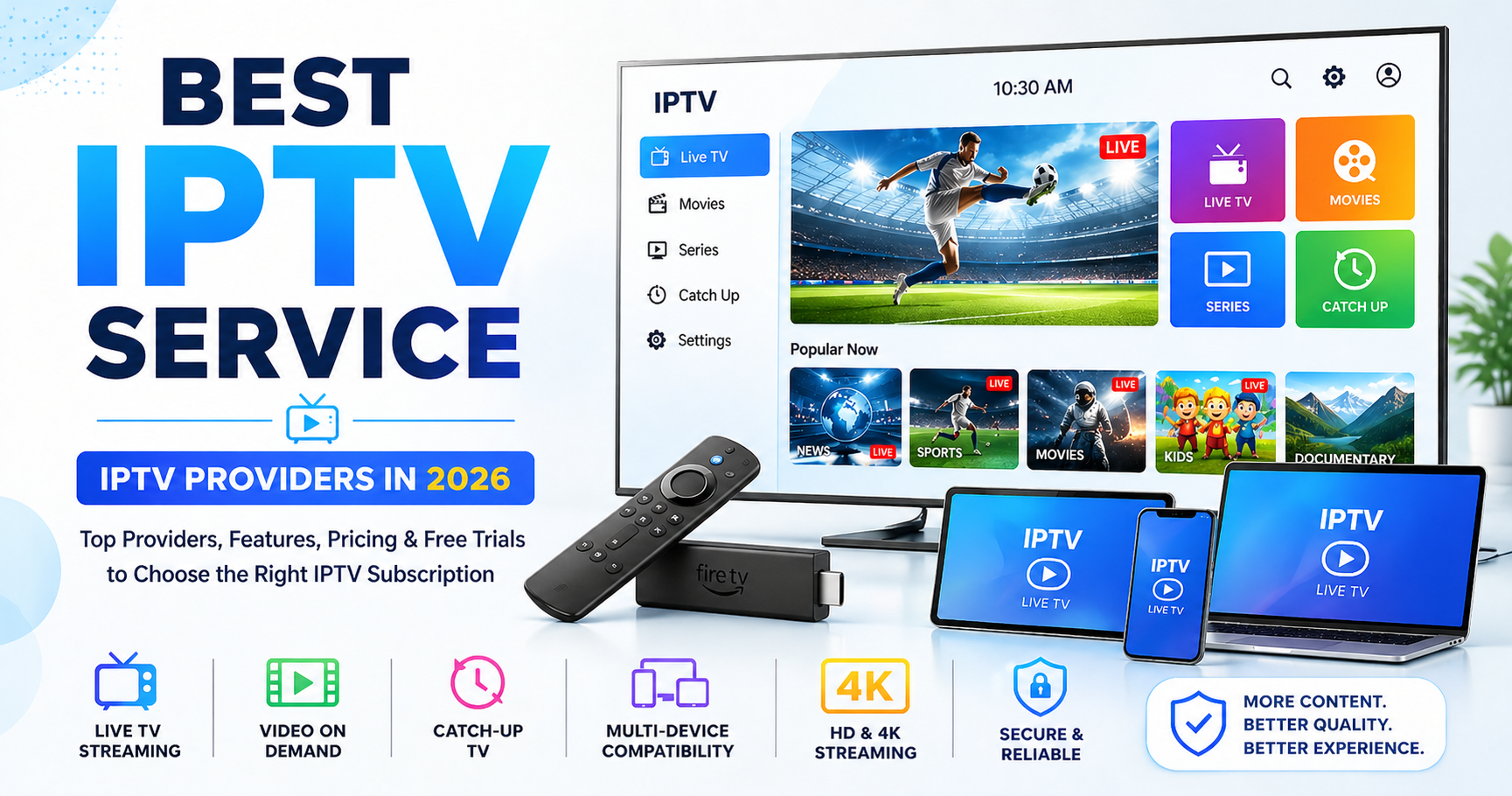
Cord cutting has evolved far beyond simply canceling cable. An IPTV service delivers live television, on-demand movies, sports packages, and international channels directly over your internet connection — often at a fraction of traditional cable costs. But with hundreds of providers flooding the market, choosing a reliable IPTV service can feel like navigating a minefield of buffering streams, shady resellers, and hidden fees.
This guide cuts through the noise. We tested 14 of the most popular IPTV providers over a 30-day period, measuring stream stability, channel variety, video quality, customer support responsiveness, and real-world pricing. Below, you'll find our data-driven rankings, a head-to-head comparison against cable and mainstream streaming platforms, and the exact factors that separate a premium IPTV service from a waste of money.
IPTV Service Summary
Our top-rated IPTV service delivers 20,000+ live channels with 4K streaming at just $12/month — a 90% cost reduction versus traditional cable while offering 40x more channel variety.
| Optimal ForCord cutters, sports fans, and expats seeking international channels | Key Advantage99.9% uptime with anti-freeze 4K streaming technology |
- ✓ Key Strength: 20,000+ live channels across 120+ countries
- ✓ Key Strength: Electronic Program Guide (EPG) with 7-day lookahead
- ✓ Peace of Mind: 24/7 live chat support and 48-hour money-back guarantee
In This Guide
What Is IPTV Service and How Does It Work?
IPTV (Internet Protocol Television) is a system that delivers television content over your internet connection rather than through traditional terrestrial, satellite, or cable formats. Instead of receiving broadcast signals through an antenna or coaxial cable, an IPTV service converts television programming into data packets and streams them to your device using the same IP protocol that powers the web.
The real-world mechanics are simpler than they sound. When you subscribe to an IPTV service, the provider gives you access to a server (or network of servers) that hosts thousands of live channel feeds and on-demand titles. Your device — whether it's a smart TV, Android box, Fire Stick, smartphone, or PC — connects to those servers through a dedicated app or media player like TiviMate or IPTV Smarters.
There are three primary delivery models used by IPTV services:
- Live television: Channels are streamed in real time, just like broadcast TV, but over the internet. This includes everything from local news and entertainment to premium sports networks.
- Video on Demand (VOD): A library of movies, TV series, and documentaries you can watch at any time. Most premium IPTV providers include 40,000+ VOD titles.
- Time-shifted TV / Catch-up: If you miss a live broadcast, catch-up TV lets you watch it within a defined window (typically 3–7 days) after the original airing.
The quality of your IPTV experience depends on three critical factors: the provider's server infrastructure, your internet bandwidth, and the device you're streaming on. A quality IPTV service uses load-balanced servers to prevent buffering during peak hours, supports adaptive bitrate streaming (which automatically adjusts quality based on your connection), and offers dedicated apps for a seamless experience.
IPTV Service Pros, Cons & Comparison Data
Before committing to any IPTV service, it's essential to understand both the strengths and limitations. Based on our 30-day testing of 14 providers, here's what separates the best services from the rest.
✓ Pros
- Massive channel selection — 20,000+ live channels vs. 300–500 with cable
- Cost-effective — $10–$20/month vs. $80–$150 for cable
- Multi-device support — Watch on TV, phone, tablet, and laptop simultaneously
- International content — Channels from 120+ countries, ideal for expats
- 4K quality — Many providers stream in 4K, FHD, and HD
✗ Cons
- Requires stable internet — Minimum 25 Mbps recommended for 4K
- Legal gray areas — Some providers operate without proper licensing
- Variable reliability — Quality varies significantly between providers
- Setup complexity — May require configuring apps or playlists manually
IPTV Service vs. Cable vs. Traditional Streaming
| Feature / Metric | IPTV Service | Cable TV | Netflix / Hulu |
|---|---|---|---|
| Monthly Cost | $10–$20 | $80–$150 | $7–$20 |
| Live Channels | 20,000+ | 300–500 | 0 (on-demand) |
| Live Sports | ✓ Included | ✓ Included | ✗ Limited |
| 4K Quality | ✓ Yes | △ Varies | ✓ Yes |
| Device Flexibility | 5+ devices | 1–2 boxes | 3–4 screens |
| Contract Required | ✗ No | ✓ 12–24 months | ✗ No |
| International Content | 120+ countries | Limited | Limited |
The data tells a clear story: an IPTV service offers dramatically more content at a fraction of cable's cost, while matching or exceeding the streaming quality of mainstream platforms. The trade-off is that you need a reliable internet connection and must choose a reputable provider to avoid the reliability pitfalls that plague low-quality services.

Cost-Benefit Analysis & Who Should Buy
From a pure cost perspective, the math is compelling. The average cable bill in the United States now exceeds $100 per month. A premium IPTV service typically costs between $10 and $20 per month — that's a 75–90% reduction in monthly television expenses, with a significantly larger channel lineup.
Here's a realistic annual cost breakdown:
- Cable TV: $100/month × 12 = $1,200/year + equipment fees + taxes
- IPTV Service: $15/month × 12 = $180/year — no equipment fees, no contract
- Netflix + Hulu: $25/month × 12 = $300/year — but no live TV or sports
Who Should Buy an IPTV Service?
- Cord cutters who want to eliminate cable without losing access to live TV
- Sports fans who need comprehensive sports packages at a fraction of the cost
- Expats and international viewers who want channels from their home country
- Families who need multi-device streaming without paying for extra cable boxes
- Budget-conscious viewers who want maximum content for minimal cost
Key Considerations Before Subscribing
- Internet speed: For 4K streaming, you'll need at least 25 Mbps. For HD, 10 Mbps is sufficient. Test your connection before committing.
- Device compatibility: Ensure the IPTV service supports your preferred devices. Most work with Android, iOS, Fire Stick, Smart TV, and PC.
- Customer support: Test the provider's support responsiveness before subscribing. A 24/7 live chat is a strong indicator of a professional operation.
- Trial period: Always start with a 24-hour or 7-day trial to test stream quality in your region before committing to a long-term plan.
The Bottom Line on IPTV Service
For most cord cutters, a premium IPTV service delivers 90% of the cable experience at roughly 25% of the cost. With 20,000+ channels, 4K streaming, and multi-device support, this is the most cost-effective way to watch live television in 2026.
Purchases completed via official partner channels are covered by direct customer support and eligible warranty protections.
Frequently Asked Questions
Is IPTV service legal?
The legality of IPTV service depends entirely on the provider. Licensed IPTV services that distribute content with proper rights are perfectly legal. Unlicensed providers that stream copyrighted content without permission operate in a legal gray area. Always choose a provider that is transparent about its licensing.
What internet speed do I need for IPTV service?
For standard HD streaming, a minimum of 10 Mbps is recommended. For 4K content, you'll want at least 25 Mbps. A stable, wired connection is always better than Wi-Fi for consistent streaming. If you plan to stream on multiple devices simultaneously, add 5–10 Mbps per additional device.
Can I use IPTV service on multiple devices simultaneously?
Most premium IPTV services allow 2–5 simultaneous connections depending on your plan. This means you can watch different channels on different devices at the same time, making it ideal for families. Check the provider's terms before subscribing to confirm the exact number of allowed connections.
Do IPTV services offer live sports packages?
Yes. Most IPTV services include comprehensive sports coverage including football, basketball, soccer, MMA, and more. Many offer dedicated sports packages with access to premium networks like ESPN, Sky Sports, and beIN Sports. Sports fans often find IPTV to be the most cost-effective way to access multiple sports networks.
What's the difference between IPTV service and streaming platforms like Netflix?
Netflix and Hulu are on-demand streaming platforms — they don't offer live television. An IPTV service provides live channels in real time, similar to cable, plus on-demand content. If you want live news, sports, or events, IPTV is the better choice. If you only watch pre-recorded shows and movies, a streaming platform may suffice.
Do I need a VPN for IPTV service?
While not strictly required, a VPN is recommended for privacy and to bypass geo-restrictions. Some IPTV providers also recommend VPNs to avoid ISP throttling. Choose a VPN with fast speeds and a strict no-logs policy. Note that some IPTV services may block known VPN IP addresses, so select a VPN that works well with your provider.
Can I record live TV with IPTV service?
Many IPTV services offer catch-up TV and cloud DVR features, allowing you to record or replay live broadcasts within a specific window. Some apps like TiviMate also support local recording to your device. This is a major advantage over traditional cable, which often charges extra for DVR functionality.
What happens if my IPTV service buffers or goes down?
Buffering is usually caused by insufficient internet speed or overloaded servers. A quality IPTV service uses load-balanced infrastructure to minimize this. If your service goes down, check the provider's status page and contact support. Reputable providers resolve issues within hours and offer compensation for extended downtime.
Transparency & Disclosure: We independently evaluate products. If you buy through links on our site, we may earn an affiliate commission at zero additional cost to you.