By Analyst Team · Updated 2026-08-11 · 11 min read
IPTV stands for Internet Protocol Television. Instead of receiving channels through a coaxial cable, a satellite dish, or an antenna, your TV receives them as digital data packets over your broadband connection. The result: you can watch the same live channels, sporting events, and premium films on a Smart TV, Firestick, phone, tablet, or PC — anywhere you have internet access. But here is the catch: the IPTV market is flooded with unreliable services, and buyers frequently regret picking the first cheap plan they find. That is exactly what this guide helps you avoid.
In the next few minutes, you will learn how IPTV works on Smart TVs and Firesticks, which criteria separate good providers from disappearing ones, and how to pick a service that fits your budget and viewing habits. We will also compare different categories of IPTV products and answer the most common buying questions.
LIMITED TIME AVAILABILITY
Unlock Full how does iptv work Access
Secure special promotional rates instantly before the window closes. Lock in your pricing model today before plans return to standard regional metrics.
Why Many People Regret Their IPTV Choice
Buying IPTV without a checklist is how most people end up disappointed. The most common regret: choosing a service based solely on monthly price. A $7 plan that buffers every ten minutes is not a bargain — it is frustration. Another frequent complaint is downloading an IPTV app on an unsupported device, only to watch it crash or refuse to load. When buyers mention this, the response from the provider is often silence.
Countless users also report providers vanishing overnight. They pay for an annual subscription, the service disappears, and there is no customer support to contact. Others share their account credentials across several devices without realizing that it triggers bans or throttling. Let us be realistic too: IPTV depends heavily on your home internet quality and the provider's server infrastructure. If either is weak, the live TV experience deteriorates quickly.
The good news? Every single one of those regrets is avoidable. Once you understand what truly matters — device support, server reliability, licensing, responsiveness — choosing the right plan becomes straightforward. The sections below walk through each of those criteria in practical terms.
What You Need to Know About the Current IPTV Market
The IPTV market in 2026 is a mixed landscape. On one end, you have licensed services like YouTube TV, Hulu + Live TV, and Sling TV — all using IPTV technology through official apps with proper content agreements. On the other end, countless unlicensed providers sell access to thousands of channels at a fraction of cable prices. These gray-market services dominate Reddit conversations and social media ads because they deliver enormous value, but they also carry real legal and technical risk.
The legal distinction matters. In the US, streaming unlicensed content is technically a copyright violation, even though enforcement usually targets the providers rather than end users. Understanding this reality positions you to make an informed choice. Meanwhile, licensed services keep raising prices, which pushes more consumers toward alternative IPTV options every year.
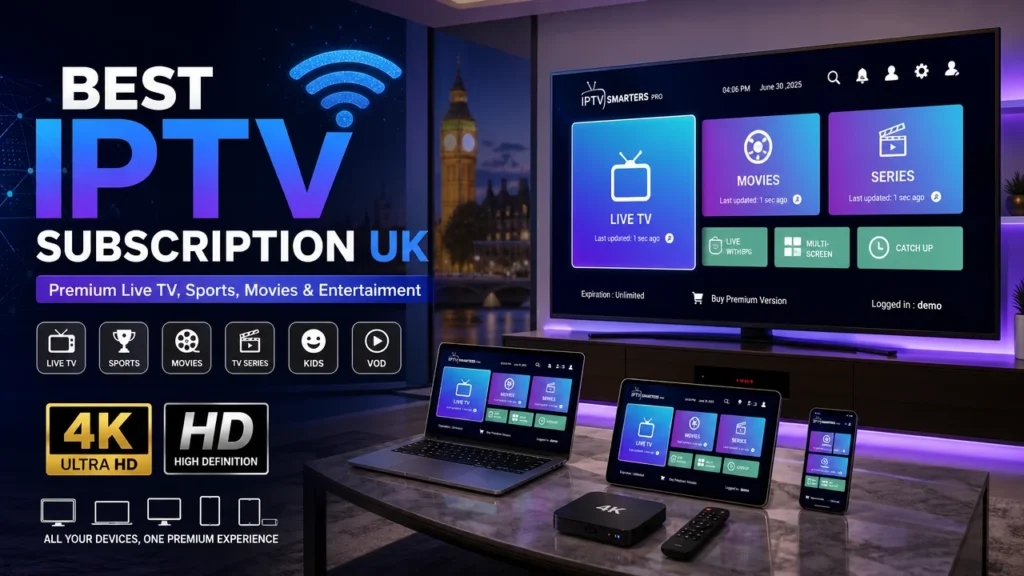
The image above illustrates the premium end of that spectrum. Providers that invest in dedicated server clusters, high bandwidth, and redundant failover systems offer a noticeably smoother experience — especially for live sports and big-event nights. Those are the providers that survive more than a couple of seasons, and they are the only ones worth your money.
Unlock complete high-definition information and priority access packs.
Claim This Special Offer for how does iptv work →Criteria That Should Drive Your Decision
Several factors matter more than the number of channels when buying IPTV. Device compatibility ranks first. Most reliable services work on Firestick, Android TV, Smart TVs, iOS, and PC — but not all of them do. If you plan to watch on a Samsung Smart TV, check for a native app or a workaround like connecting a Firestick to the HDMI port.
Server reliability is second. Ask prospective providers about their infrastructure. Established providers own or rent dedicated server clusters with balanced load distribution, which translates into fewer buffering episodes during prime-time sports. Ask about their uptime track record over the last 12 months, not just their marketing promises.
Other criteria worth weighing: channel packaging (sports bundles, international channels, adult content restrictions), support availability (24/7 live chat is a strong signal), and whether the provider offers a short trial or money-back guarantee. A confident provider will let its product prove itself before asking for your full payment.
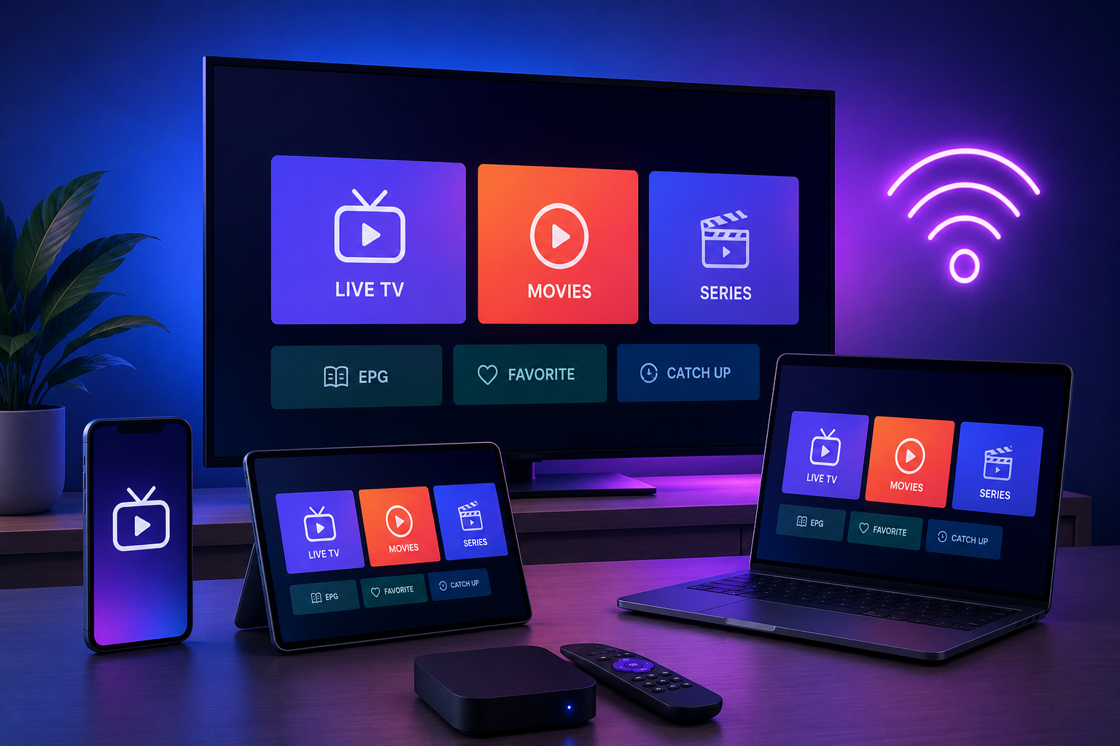
A modern IPTV interface, as seen above, brings live channels, movie libraries, and series catalogs into a single unified dashboard. That convenience is exactly why many former cable subscribers make the switch. But convenience only holds up when the underlying service is stable and the streaming quality matches your connection capability.
Questions to Ask Before Buying
You should not hesitate to interrogate a provider before handing over your email and card details. Here are the questions that matter most:
- Do you support my device? Do not assume. Ask for the complete device compatibility list.
- Can I test the service first? A 12- to 24-hour trial is standard among reputable providers.
- What is your uptime policy? Reliable providers target 99.9% uptime and explain their server redundancy.
- How many simultaneous connections do I get? One stream may be too limiting for a household.
- Do you offer a refund if the service goes down? Get it in writing, not just as a verbal promise.
- Where is your support team located? 24/7 live chat is a strong indicator of professional operations.
- What is the billing structure? Monthly billing is safer than annual for first-time buyers.
- How frequently do you update channels? Constant dead channels indicate provider health issues.
Warning Signs to Spot
Avoid providers that demand payment only in cryptocurrency. Legitimate companies are comfortable accepting cards or PayPal, which also gives you chargeback protection if the service fails. Be wary of "lifetime subscriptions" — no IPTV service can guarantee lifetime access unless it owns serious licensing, which most do not. If the price is dangerously low for thousands of channels, the service is likely unstable or entirely unlicensed.
Also watch for providers that aggressively suppress discussions about their service on forums like Reddit. Services that monitor user reviews closely usually have something to hide. A trustworthy provider invites scrutiny and public feedback.
Comparison Table: Available Options at a Glance
| Provider Type | Monthly Price | Channels | Uptime | Device Support | Best For |
|---|---|---|---|---|---|
| Premium IPTV Plan | $12–$20 | 15,000+ | 99.9% | Firestick, Smart TV, iOS, Android, PC | Sports fans & families |
| Licensed IPTV / Cable Apps | $30–$50 | 100–200 | 99.9% | All major platforms | Legal certainty |
| Budget IPTV | $5–$10 | 5,000–8,000 | 90–95% | Firestick, Android | Casual viewing |
| Free IPTV Playlists | $0 | 500–1,000 | 60–80% | Varies | Testing only |
Pros and Cons of IPTV Compared to Cable
Pros
- Lower cost — often 50–70% cheaper than cable
- Multi-device support — TV, phone, tablet, PC
- No long-term contracts or hidden fees
- Massive channel selection, including international content
- Instant activation — no technician visit needed
- VOD libraries with movies and series included
Cons
- Depends on your home internet bandwidth
- Unlicensed providers operate in a legal gray zone
- Potential for sudden service shutdowns
- No 911 or local emergency broadcast integration
- Quality varies significantly between providers
- Customer support can be slow or nonexistent
Recommendation by Budget and Needs
Best overall value: For most households, a premium IPTV subscription in the $12–$20 range strikes the right balance between channel count, stability, and device flexibility. Look for providers that offer 24/7 support, a trial period, and proven uptime history. Our current market favorite is buyiptv3.com because of its server redundancy and responsive support team.
Sports fans: If live sports is your priority, prioritize providers with 4K/60fps channels, multi-country feeds, and anti-lag infrastructure. A dropped match in the 88th minute is unforgivable. Ask the provider directly about their sports channel sourcing and whether they carry regional sports networks (RSNs).
Privacy-conscious users: Use a reliable VPN with your IPTV setup, especially if you are accessing unlicensed content. A VPN encrypts your traffic and prevents your ISP from throttling your connection based on streaming patterns.
Budget-limited users: If you can only spend $5–$10 per month, stick to month-to-month billing and never prepay for a full year. A budget plan can still offer a decent experience for casual evening viewing, but manage your expectations during peak hours.
How to Maximize Your IPTV Investment
Your IPTV experience is only as good as your connection and your setup. Start by testing your internet speed. You need at least 25 Mbps for smooth HD streaming and 50 Mbps or higher for 4K content on multiple devices. Whenever possible, connect your streaming device through an ethernet cable rather than Wi-Fi. A wired connection eliminates interference and gives you the most stable throughput for live events.
Next, invest in a quality streaming device. The Amazon Firestick 4K and NVIDIA Shield TV handle IPTV apps exceptionally well. Update your device firmware regularly and clear app caches periodically to prevent sluggish performance. If you experience buffering despite a solid connection, switch to a different DNS server (1.1.1.1 or Google 8.8.8.8) and consider using a VPN to bypass ISP throttling.
Finally, protect your purchase. Use a unique password for your IPTV account, enable two-factor authentication when available, and never share credentials publicly. If a provider suddenly shuts down, having a monthly billing plan protects you from losing a large prepaid amount. A little preparation goes a long way toward a smooth streaming experience.
Final Subscription Window:
Main Offer Today →Affiliate Disclosure: Clicking this secure link verified by our network supports our team through standard partnership terms at zero extra cost to your invoice.
Frequently Asked Questions
1. How does IPTV work on Smart TV?
IPTV works on Smart TVs through dedicated apps that connect to your provider’s login server. Once authenticated, the app receives channel streams over your home internet connection using protocols like HTTP or UDP. Most Smart TVs from Samsung, LG, and Android TV models can run IPTV apps without additional hardware. You typically just need the provider’s playlist or portal URL and your account credentials.
2. Is IPTV legal in the US?
The technology itself is entirely legal in the US — IPTV simply moves TV signals over the internet. The legality depends on the provider’s licensing. Major services like YouTube TV and Hulu + Live TV distribute content legally through IPTV. Unlicensed providers that stream copyrighted channels without permission operate outside the law, and using those services carries a degree of legal and financial risk. Always confirm a provider has proper content licensing before subscribing.
3. IPTV vs cable — which is better?
IPTV generally wins on price, channel selection, and device flexibility — you can watch on tablets, phones, and projectors in addition to your primary TV. Cable offers more consistent reliability because it is not dependent on your home internet quality. If your broadband speed is 25 Mbps or higher and the provider uses solid infrastructure, IPTV is almost always the better value. Traditional cable also locks you into annual contracts while most IPTV plans are monthly.
4. How to set up IPTV on Firestick?
After enabling “Apps from Unknown Sources” in the Amazon Firestick settings, install an IPTV player like TiviMate or IPTV Smarters. Open the app, enter the provider’s server URL, username, and password, and the channel list loads automatically. A VPN is recommended to protect your privacy depending on your jurisdiction. The entire setup takes about five minutes.
5. Why does IPTV keep buffering?
Buffering usually stems from three problems: insufficient internet speed, overloaded provider servers, or Wi-Fi interference. Check your speed first — you need at least 25 Mbps for HD streams and 50 Mbps for 4K, with a wired ethernet connection being ideal. If your connection is fast, the problem is likely server-side. Choose a provider with redundant server networks that does not over-allocate bandwidth per user.
6. What is the best IPTV service for live sports?
Sports fans should prioritize providers with high uptime stability, dedicated sports channel bundles, and anti-lag streaming. Look for multi-country sports feeds, 4K/60fps options, and proven infrastructure that handles peak event traffic without dropping streams. A short trial period is the safest way to verify whether a provider can handle the sports channels you care about.
7. Where to buy a reliable IPTV subscription?
Avoid random sellers on social media or Telegram. Instead, use established providers that offer a trial, a professional website, transparent pricing, and live customer support. Our recommended provider is buyiptv3.com — it has strong server architecture, responsive support, and a track record of stability that matches what serious viewers expect from an IPTV plan.
8. What do people on Reddit say about IPTV in 2025?
Reddit’s r/IPTV threads reflect a consistent consensus: avoid bargain-bin $5-per-month services because most vanish within weeks. Users regularly warn about providers that overpromise channel counts and then deliver dead links. The most recommended providers have long operating histories, active community presence, and stable trial-period policies. Scan the sticky posts and banned-provider lists before you commit — the community does a lot of the research for you.